
When the Pool’s Edge Starts to Fail
Coping and Travertine Remodeling in St. Augustine
Pool coping is the capstone material that covers the edge where the pool shell meets the surrounding deck—it protects the bond beam beneath it, directs surface water away from the pool’s perimeter, and defines the transition between the pool and its surroundings. Village Pool & Patio performs coping and travertine remodeling in St. Augustine for homeowners whose coping has cracked, loosened, or aged past the point where the original material continues to function. Loose or displaced coping allows water to migrate behind the pool edge, which accelerates deterioration of the bond beam and surrounding materials—a condition that often surfaces as coping sections that rock underfoot or recurring tile displacement near the pool’s perimeter.
Before recommending replacement, Village Pool & Patio evaluates the bond beam beneath the existing coping. Sections that have only lost their adhesive bond are a different scope than coping that has displaced because the beam beneath it has cracked or settled. Installing new coping material over a compromised beam restores the appearance without addressing the structural condition, which typically leads to the same failure pattern on the new installation. The evaluation also includes drainage joint design and transitions to surrounding surfaces—factors that affect how the finished coping performs over time.
Schedule a coping assessment with Village Pool & Patio to evaluate your pool’s edge condition and discuss whether travertine or another coping material fits your pool’s configuration.
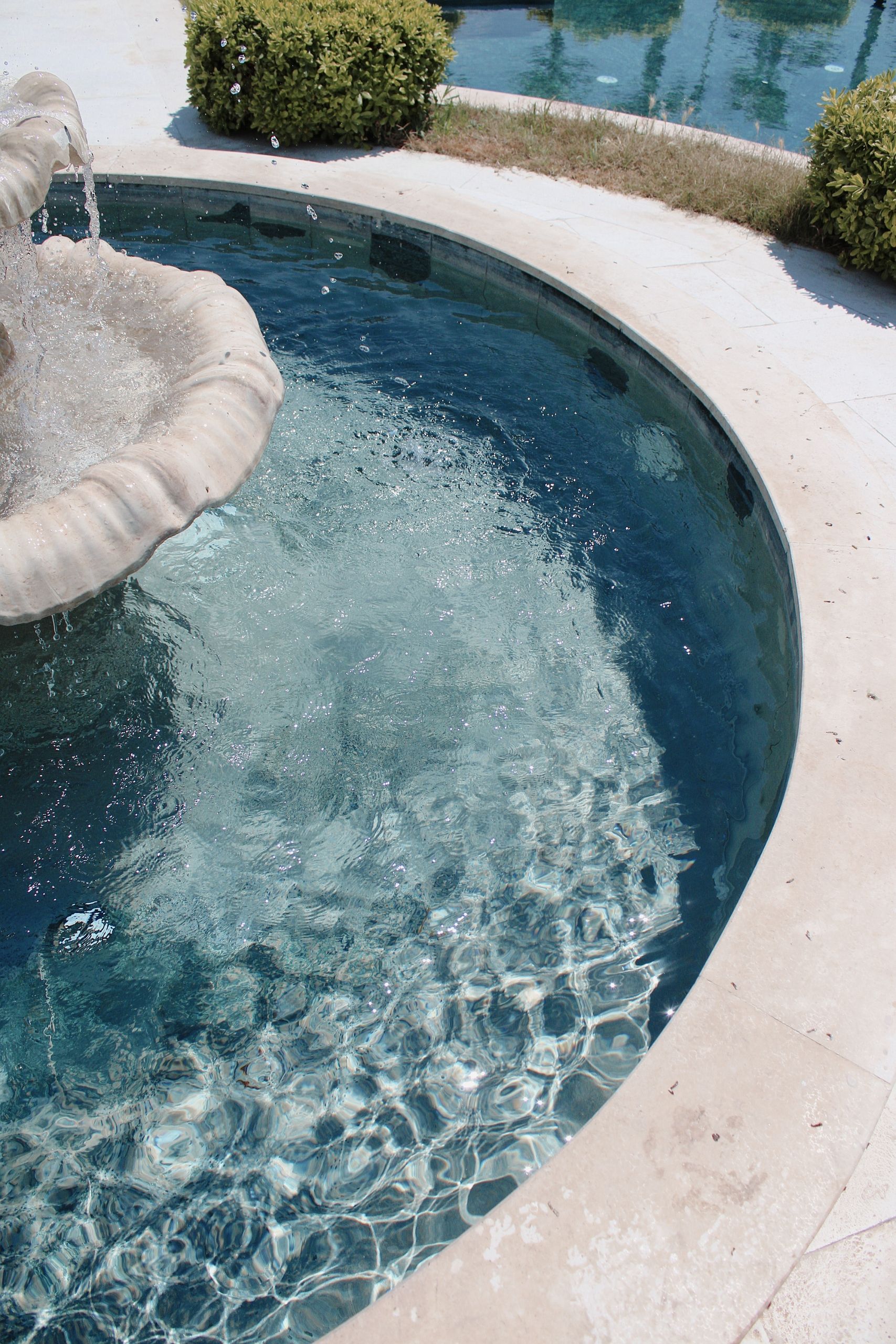
Why Travertine Works at the Pool Edge
Travertine is a naturally porous stone filled and honed for pool coping applications, and its appeal comes from the variation in tone and texture across individual pieces. Village Pool & Patio sources travertine appropriate for pool coping—material selected for edge thickness, fill quality, and dimensional consistency. Many St. Augustine pools installed during the 1980s and 1990s were originally finished with brick or poured concrete coping, and travertine remodeling updates the pool’s edge to current aesthetic standards while maintaining dimensional compatibility with the existing shell. After installation, coping joints are sealed to limit water migration behind the edge, and the finished coping should sit flush with the surrounding deck at the correct drainage angle with no movement underfoot along its length.
Travertine requires periodic maintenance to retain its appearance—the fill material in the stone’s natural voids degrades over time and may need to be reapplied. Surface resistance to chemical exposure varies across travertine products and finish types, so the selection of travertine finish and sealer should account for the pool’s water chemistry and splash-zone conditions. Travertine is not uniformly slip-resistant in all conditions, and the specific finish selected affects traction characteristics at the pool edge.
Coping and travertine work is practical to coordinate with waterline tile replacement and pool interior resurfacing, since the visual transitions between coping, tile, and interior surface are most effectively managed when material selections are made together.
Questions About Coping and Travertine Work
Coping questions often center on what causes pieces to loosen, how much of the underlying structure is involved, and what maintenance travertine requires after installation.
Q: What causes pool coping to become loose over time?
A: The setting material beneath coping breaks down from water exposure and movement at the expansion joint between the coping and the deck. When the bond fails, sections shift or rock underfoot and open gaps that allow water to migrate behind the pool’s structural edge.
Q: How is the bond beam evaluated before coping replacement?
A: Once loose sections are removed, the beam surface beneath them is inspected for cracking, spalling, or evidence of water intrusion. If the beam shows structural damage, that scope is addressed before new coping is installed—setting coping over a damaged beam does not resolve the beam condition and does not prevent the same failure from recurring.
Q: Does travertine require sealing after installation at the pool edge?
A: Most travertine used for pool coping is sealed after installation to limit moisture penetration into the stone’s natural voids and to protect the fill material. The appropriate sealer type depends on the specific finish selected and the pool’s water chemistry and splash patterns.
Village Pool & Patio is available to review your coping condition, discuss travertine material options, and coordinate with related services including pool repair, waterline tile replacement, and pool interior resurfacing.